You’ve been invited to a friend’s mosque, or perhaps you’re visiting one while traveling — and now you’re standing in front of your wardrobe genuinely uncertain. Not about whether to go. About what to wear.
This is one of the most common and least well-answered questions in the space between cultures: what to wear to a mosque as a non-Muslim woman. Most guides give you a checklist — cover your hair, wear long sleeves, no shorts — and leave you to figure out the rest. What they rarely address is how to do this with actual elegance. How to dress in a way that genuinely honors the space rather than simply satisfying a technical requirement.
This guide answers that question completely — from the core principles behind mosque dress etiquette, to seven specific outfit ideas that are both respectful and beautiful.
Why Getting This Right Matters More Than You Think
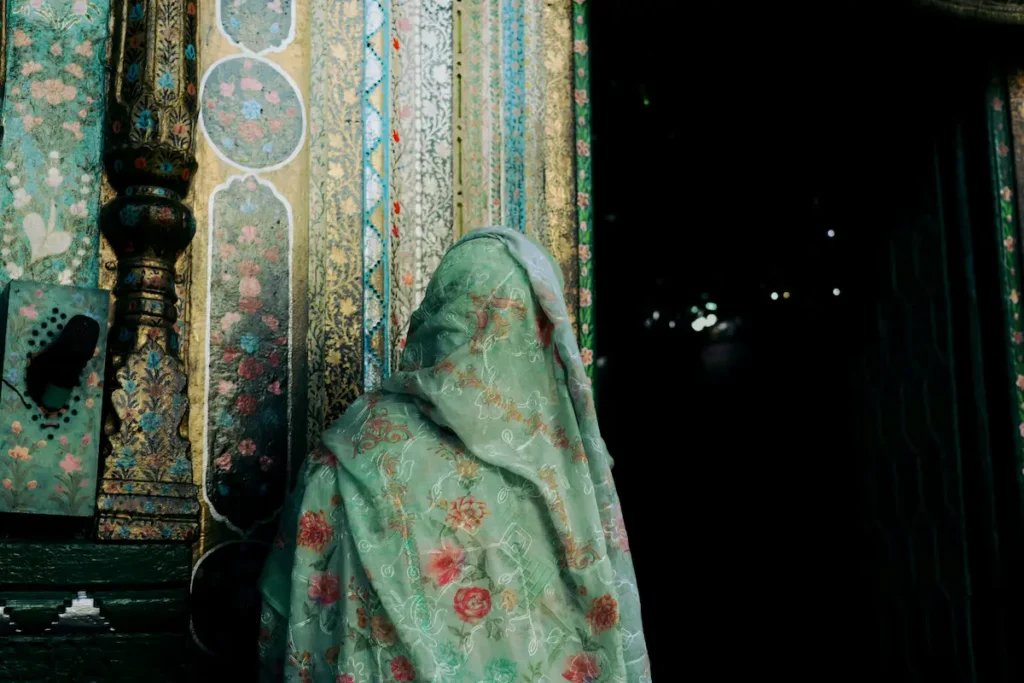
Walking into a mosque underdressed — even unintentionally — creates an uncomfortable situation for everyone involved. It signals, however innocently, that the space and its community weren’t considered in advance. For women who are guests of Muslim friends or colleagues, this can affect a relationship that matters.
The reverse mistake is equally common: over-dressing in a way that reads as costume rather than genuine respect. A woman who arrives in borrowed, ill-fitting traditional dress she’s never worn before often looks less culturally aware than one who has dressed thoughtfully in her own modest clothing.
The goal is not to look Muslim. The goal is to dress with enough consideration that your presence communicates: I understand that this space is significant, and I came prepared to honor it. That distinction shapes every outfit suggestion in this guide.
The Core Principles of Mosque Dress for Non-Muslim Women
Before the outfit ideas, three principles govern every good choice.
Coverage: What Is Actually Required
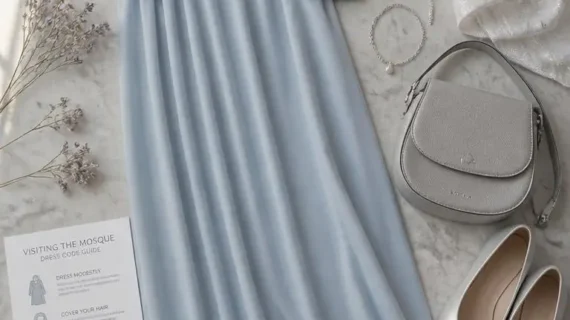
For women visiting a mosque, regardless of faith, the minimum coverage requirements are:
- Hair and neck covered — a scarf, wrap, or shawl draped over the head and secured at the neck
- Arms covered to the wrist — long sleeves are standard; a lightweight cardigan or shawl over a shorter sleeve works
- Legs covered to the ankle — trousers, a long skirt, or a maxi dress
- Feet — shoes are removed before entering the prayer area; clean, neat socks are appropriate
These requirements are consistent across most mosques globally, with minor variations. Some mosques provide scarves and abayas for non-Muslim visitors at the entrance — but relying on this is not ideal. Arriving prepared shows considerably more respect than borrowing at the door.
Modesty: Beyond Just Coverage
Coverage and modesty are related but different. A long-sleeve top that is sheer or very form-fitting meets the letter of the coverage requirement but not its spirit. Mosque modesty means clothing that is:
- Not sheer or transparent
- Not form-fitting to the point of accentuating the body’s contours
- Free of prominent logos, graphic prints, or text
- In muted, non-attention-seeking colors where possible (though this is a preference, not a rule)
Ease of Movement
The prayer hall floor requires shoes to be removed. You will walk on carpet, potentially sit cross-legged, and move through a space where others are praying. Outfit choices should account for this: nothing that requires constant adjustment, nothing that drags on the floor significantly, and nothing with complicated ties or fastenings that shift when you move.
7 Outfit Ideas for Visiting a Mosque as a Non-Muslim Woman
Outfit 1: The Linen Maxi Dress with Shawl
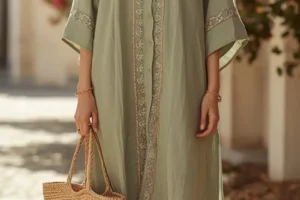
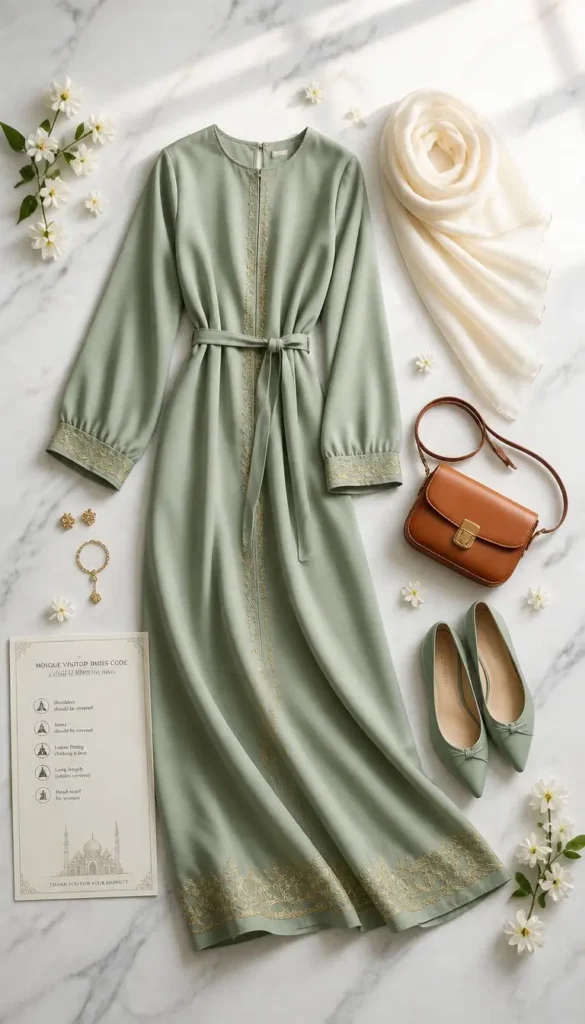
The look: A loose, full-length linen dress in a muted tone — cream, sage, dusty blush, or soft navy — worn with a lightweight shawl draped over the hair and shoulders.
Why it works: Linen is a fabric that naturally communicates ease and consideration. It’s cool in warm climates (where many mosque visits occur during travel), moves gracefully, and requires no additional layers to achieve the coverage needed. The shawl does double duty — headcovering and shoulder coverage in one piece.
The same principle that makes linen such an elegant choice for mosque visits also makes it ideal for other warm-weather modest occasions — a point explored in depth in our guide on why a linen abaya is the ideal warm-weather modest garment.
Pair with: Simple leather sandals (easy to remove), natural stone jewelry, a structured tote.
Outfit 2: Wide-Leg Trousers and a Longline Modest Top
The look: Tailored wide-leg trousers in a neutral — camel, charcoal, or warm white — with a longline modest top or tunic that covers the hips. A silk-blend scarf tied loosely over the hair completes it.
Why it works: This is the most “everyday” of the mosque visit outfits — it looks polished and intentional without requiring any specialized modest fashion purchases. Women who travel frequently and visit mosques as part of cultural tourism find this combination endlessly versatile.
Pair with: Slip-on loafers or minimal sandals, a structured crossbody bag, no statement jewelry.
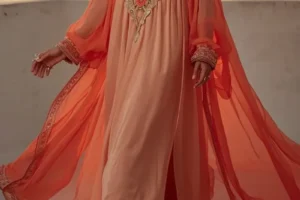
Outfit 3: A Full-Length Abaya
The look: An open-front or closed abaya in a lightweight natural fabric — cotton, linen, or bamboo viscose — worn over whatever you have underneath, with a matching or tonal scarf.
Why it works: This is the simplest and most complete solution for mosque visits. A single abaya eliminates every coverage question simultaneously and allows the visitor to be fully present in the experience rather than managing her clothing.
For non-Muslim women who visit mosques regularly — whether for interfaith events, travel, or community engagement — owning one quality abaya is a practical investment that outlasts dozens of situational styling decisions. A lightweight cotton abaya for warm weather is the ideal starting point: breathable, easy to pack, and appropriate across a wide range of mosque environments.
Pair with: Any comfortable footwear that slips on and off easily, minimal accessories.
Outfit 4: A Midi Skirt and Long-Sleeve Blouse
The look: A flowing midi or maxi skirt — not bodycon — in a solid color or subtle pattern, with a long-sleeve blouse tucked in. A pashmina or wrap scarf over the hair and shoulders.
Why it works: This combination is familiar and non-intimidating for women who have never dressed modestly before. It uses pieces likely already in the wardrobe and requires only the addition of a quality scarf for headcovering.
Key detail: The skirt must be opaque and full enough to move freely without clinging. Wrap skirts with slits are not suitable. A-line and gathered silhouettes work best.
Pair with: Flat sandals or ballet flats, a simple tote bag, no jewelry that makes noise.
Outfit 5: A Hooded Modest Outer Layer
The look: A hooded open-front modest robe or kimono abaya worn over a coordinating modest outfit underneath. The hood provides built-in headcovering — no scarf management required.
Why it works: For women who find scarf styling difficult or uncomfortable, a hooded modest outer layer solves the headcovering requirement without any pinning or re-draping. The hood stays in place naturally and reads as elegant rather than improvised.
This is a particularly thoughtful choice for women who know they will be moving through different mosque spaces — entering, sitting, touring — where a loosely draped scarf might shift repeatedly. Pieces like the hooded batwing abaya with tassel detail bring genuine craft heritage to the practical function of headcovering — a combination that resonates especially in historically significant mosque settings.
Pair with: Simple coordinating inner outfit, slip-on shoes, minimal accessories.
Outfit 6: The Travel-Ready Modest Set
The look: A matching modest set — wide-leg trousers and a long-sleeve modest top in the same fabric and color — worn as a coordinated unit. A long rectangular scarf in a complementary tone for headcovering.
Why it works: Matching sets read as intentional and polished even when the individual pieces are simple. For travel contexts where mosque visits are planned among multiple activities, a set that packs flat, resists wrinkles, and transitions between environments is genuinely practical.
Best fabrics: Jersey, modal, or washed cotton — all pack well, require no ironing, and maintain their shape through a full travel day.
Outfit 7: The Smart Casual Modest Look
The look: Dark slim-fit trousers (not leggings) with a long, modest tunic or shirt-dress that covers the hips — in a quality cotton or linen blend. A rectangular silk or cotton scarf for headcovering.
Why it works: This is the office-to-mosque outfit — appropriate for women who have a mosque visit during or after a working day. The smart casual register respects the space without requiring a complete outfit change.
Important: Ensure the tunic or shirt-dress is genuinely long enough to cover the hips fully when moving. What appears long enough standing still may not be when sitting, kneeling, or walking.
How to Drape a Headscarf if You’ve Never Done It Before
This is the question most non-Muslim women are too embarrassed to ask directly — and it shouldn’t be. Draping a headscarf for the first time is entirely learnable in ten minutes.
The simplest method:
1. Take a large rectangular scarf
   (minimum 170cm x 60cm)

2. Fold it lengthwise into thirds
   (narrower, easier to manage)

3. Center it on your head with
   equal lengths on both sides

4. Bring both sides under your chin

5. Cross them once under the chin

6. Bring both ends back and
   tuck into the fabric at the neck

7. Adjust so the forehead line
   sits where you want it
No pins required. This basic wrap stays in place for several hours with minimal adjustment — practical for a mosque visit of any length.
Colors and Fabrics: A Quick Reference
| Color | Suitable | Notes |
|---|---|---|
| White, ivory, cream | ✅ Excellent | Classic, clean, widely appropriate |
| Soft neutrals (sage, blush, camel) | ✅ Excellent | Elegant and non-attention-seeking |
| Deep jewel tones (navy, forest, burgundy) | ✅ Good | Rich and respectful |
| Bright primaries | ⚠️ Caution | Not inappropriate, but draws attention |
| Black | ✅ Excellent | Standard and universally appropriate |
| Neon or high-contrast patterns | ❌ Avoid | Visually disruptive in a sacred space |
| Fabric | Suitability | Notes |
|---|---|---|
| Linen | ✅ Excellent | Breathable, elegant, travels well |
| Cotton | ✅ Excellent | Comfortable, widely available |
| Modal/Bamboo | ✅ Good | Soft, drapes well |
| Silk blend | ✅ Good | Elegant for special occasions |
| Sheer chiffon | ❌ Avoid alone | Needs lining or layering |
| Denim | ⚠️ Caution | Casual register; full-coverage style only |
FAQ: What to Wear to a Mosque as a Non-Muslim Woman
Q: Do I have to cover my hair to visit a mosque? Yes — in virtually all mosques globally, women are required to cover their hair when entering the prayer hall. Some mosques have separate areas for non-Muslim visitors where this requirement is relaxed, but covering the hair is the safe and respectful default. Bring a scarf regardless, and use it.
Q: Will a mosque provide clothing if I arrive without appropriate dress? Many mosques do offer scarves and simple abayas for visitors at the entrance — particularly those that welcome non-Muslim visitors as part of open-door or interfaith programs. However, arriving prepared is always more respectful than relying on borrowed clothing. If you know you’ll be visiting, dress appropriately in advance.
Q: Can I wear trousers to a mosque? Yes — trousers are entirely acceptable for women visiting a mosque, provided they are loose-fitting, not sheer, and paired with a top that covers the hips fully. Slim-fit or form-fitting trousers that accentuate the body’s shape are better replaced with wide-leg or relaxed styles.
Q: Is there anything I should avoid wearing regardless of coverage? Graphic text, prominent logos, political or religious symbols from other faiths, and clothing with imagery of living beings are all best avoided. Fragrance — particularly strong perfume — is also worth being mindful of in a mosque environment, as it can be distracting to those in prayer.
Q: What shoes work best for a mosque visit? Slip-on shoes are ideal — loafers, sandals, or flat mules that can be removed quickly at the entrance without fumbling. Avoid boots with multiple buckles or laces that require significant time to remove and replace. Bring clean, neat socks regardless of the weather.
The Closing Thought
Knowing what to wear to a mosque as a non-Muslim woman is ultimately about approaching a sacred space with the same care you would give any significant cultural encounter — thoughtfully, respectfully, and with enough preparation to be fully present in the experience rather than preoccupied with your clothing.
The women who navigate this most gracefully are not those who arrive in elaborate traditional dress they’ve never worn before. They’re the ones who dressed simply, covered appropriately, and walked in with genuine curiosity and respect.
At AriyaEthno, we believe that modest dressing — whether for faith, travel, culture, or personal choice — is always most beautiful when it comes from understanding rather than obligation. If you’re building a wardrobe that serves these occasions with elegance and ease, explore our curated modest fashion collection — each piece chosen with exactly this kind of thoughtful dressing in mind.