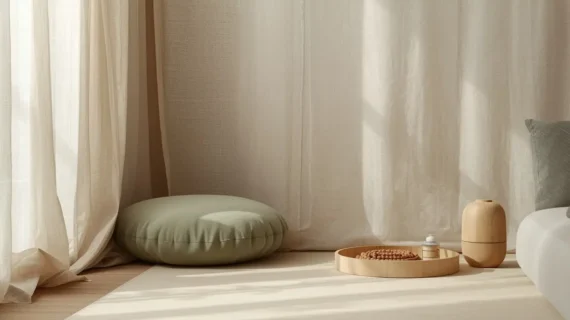
Knowing how to decorate a prayer room at home beautifully is not about spending more or accumulating more. It’s about understanding what makes a space feel genuinely set apart — and then making a small number of deeply intentional choices that serve that feeling consistently.
There’s a particular disappointment that comes from setting aside a corner of your home for prayer — clearing the space, buying a rug, perhaps hanging something on the wall — and then standing in it and feeling nothing different from the rest of the house. The intention was sacred. The result is just a corner with a rug.
This guide covers eight specific design ideas for creating a home prayer room that is both aesthetically refined and spiritually resonant — whether you’re working with a dedicated room, a spare corner, or a modest alcove.
Why Most Home Prayer Spaces Fall Short
The most common mistake in creating a prayer space at home is treating it as a decorating project rather than a design problem. People approach it the same way they approach any room — adding things until it looks “decorated” — and end up with a space that is visually busy but spiritually quiet in the wrong direction.
A cluttered prayer room creates visual noise that competes with the stillness prayer requires. A space filled with too many symbolic objects — calligraphy prints, lanterns, prayer beads, plants, and decorative books all competing for attention — becomes harder to enter mentally than a clean, simple corner with a single well-chosen piece.
The second common mistake is prioritizing aesthetics over function. A beautiful prayer rug that isn’t comfortable to kneel on for extended periods serves the photographer, not the worshipper. A qibla indicator positioned incorrectly because it “looked better” on another wall defeats the space’s primary purpose entirely.
The third — and perhaps most telling — mistake is creating a space that doesn’t feel meaningfully different from the surrounding rooms. If the prayer corner feels like an extension of the living room rather than a departure from it, the mind doesn’t shift the way it needs to when entering it.
Understanding how to decorate a prayer room at home beautifully means solving all three of these problems simultaneously: visual calm, functional integrity, and a sense of genuine separation from daily life.
The Foundation: What Every Beautiful Prayer Room Needs First
Before any decorative decision is made, three non-negotiable functional elements must be established correctly.
1. Correct Qibla Orientation
The prayer space must face Mecca — accurately. Use a reliable qibla compass app (multiple verified options are available on both iOS and Android) rather than estimating. Once confirmed, mark the orientation clearly before placing any furniture or decorative elements.
2. Clean, Unobstructed Floor Space
The prayer rug needs to lie flat on a clean surface. Hardwood, tile, and low-pile carpet all work. Deep pile rugs beneath a prayer rug create instability during prostration. The floor area immediately in front of and around the prayer rug should be kept consistently clear.
3. Privacy and Quiet
Even in a shared home, the prayer space should feel visually separated from high-traffic areas. A curtain, a folding screen, a bookshelf used as a divider, or simply positioning the space away from doorways and televisions — all of these create the psychological separation that makes entering the space feel meaningful.
8 Beautiful Ideas for Decorating a Prayer Room at Home
Idea 1: Choose a Wall Color That Does the Work
Color is the most powerful and most underused tool in prayer room design. The right wall color shifts the room’s emotional register the moment you enter — before a single decorative object is placed.
Colors that create calm:
- Warm white or soft ivory — clean, open, non-denominational calm
- Sage green — natural, grounding, associated with growth and peace
- Soft terracotta — warm, earthy, reminiscent of North African sacred spaces
- Pale blush or dusty rose — feminine, soft, gentle on the eyes during long prayer sessions
- Deep teal accent wall — used only on the qibla-facing wall, creates focused depth
Avoid bright whites (clinical and energetically cold), bold primaries, and high-contrast patterns directly within the prayer space’s sightline.
Idea 2: Invest in One Exceptional Prayer Rug
This is the single most important purchase in creating a beautiful prayer room. A quality prayer rug — in fine wool, hand-knotted cotton, or premium synthetic with authentic pattern integrity — anchors the entire space visually and serves the worshipper practically.
What to look for:
- Density: A rug with enough pile to cushion extended prostration without being so thick it creates instability
- Pattern clarity: Traditional geometric or mihrab (arch) patterns carry visual authority without requiring additional wall art
- Color coherence: The rug’s palette should inform every other color choice in the room — not the other way around
One common and costly mistake: buying a decoratively impressive prayer rug that is impractical for daily use, then keeping it rolled up to “preserve it.” A prayer rug kept in storage serves no one. Choose one you will use every single day — beauty and practicality are not in opposition here.
Idea 3: Use Moroccan Lanterns for Atmospheric Lighting

Lighting is what separates a beautiful prayer space from a truly atmospheric one. Overhead lighting — particularly harsh overhead fluorescents — is one of the fastest ways to undermine the sacred quality of a prayer room.
Moroccan lanterns, positioned at floor level or on low shelves flanking the prayer rug, cast geometric light patterns that shift with the flame and create a visual environment genuinely unlike any other room in the house. The geometric patterns — based on mathematical principles recurring throughout Islamic art — resonate specifically within a prayer context in ways that other decorative lighting simply doesn’t.
For complete guidance on choosing, placing, and pairing Moroccan lanterns in your home, our detailed resource on Moroccan lantern home decor ideas covers the material, scale, and placement principles that make the difference between a beautiful object and a transformed space.
Use flameless LED candles inside the lanterns during prayer for safety — quality flameless options at low brightness are entirely convincing and allow you to focus on prayer rather than managing flame.
Idea 4: Arabic Calligraphy — One Piece, Placed Precisely
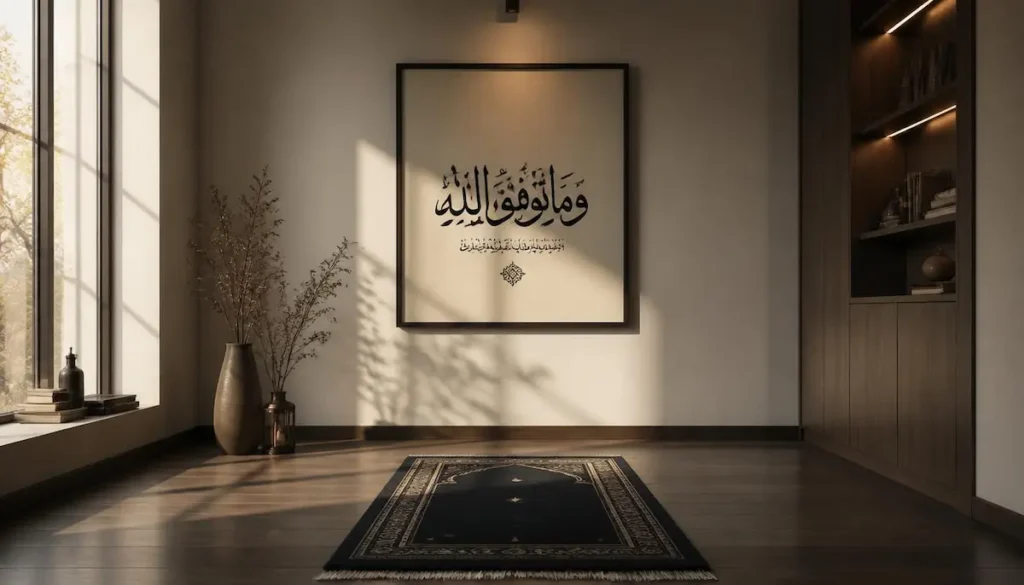
The instinct to fill the prayer room’s walls with multiple calligraphy prints is understandable — each piece is beautiful individually. But multiple calligraphy works competing on the same wall create visual noise rather than focused reverence.
The rule: One piece of Arabic calligraphy, hung directly on the qibla-facing wall at eye level when seated or in prostration. Everything else remains clear.
The choice of text matters:
- Ayat Al-Kursi (The Throne Verse) — deeply protective, widely displayed
- Bismillah — simple, clean, appropriate for any size space
- Surah Al-Fatiha — complete, familiar, spiritually encompassing
- Allah and Muhammad (paired) — balanced, traditional, visually symmetrical
Choose canvas or high-quality framed print in a frame color that matches the room’s metal palette — brass for warm tones, matte black for cooler, minimal aesthetics.
According to interior design research published by the Islamic Arts Magazine, the most spiritually effective sacred spaces use a single primary focal element rather than distributed decoration — a principle that applies directly to the prayer room calligraphy decision.
Idea 5: A Dedicated Quran Stand and Storage
A prayer room that requires searching for the Quran before each use loses something in the transition. A dedicated Quran stand — in carved wood, brass, or a simple modern rehal — positioned beside the prayer rug keeps the Quran accessible, protected, and visually honored as the space’s most important object.
Wooden Quran stands with carved geometric detail are both functional and deeply beautiful. Place it to the right of the prayer rug when facing qibla. At the base, a small woven basket or wooden tray holds prayer beads, a small clock for prayer time reference, and any other daily-use items — keeping the floor clear while maintaining order.
The visual weight of a beautiful Quran stand elevates the entire space with a single piece. I’ve observed this consistently across prayer spaces in homes from London to Kuala Lumpur — when the Quran stand is a considered, quality object, the entire room around it reads as more intentional.
Idea 6: Natural Textiles for Warmth Without Weight
Beyond the prayer rug, natural textiles introduce warmth, texture, and cultural resonance without adding visual clutter. The key is restraint — one or two textile additions, maximum.
Options by placement:
- A simple linen or cotton curtain dividing the prayer space from the room — natural fibers drape beautifully and create a soft, non-institutional separation
- A small cushion for those who need support during extended seated dhikr (remembrance) — in a fabric tone that harmonizes with the prayer rug
- A folded throw on a low shelf for cooler seasons — in natural wool or cashmere blend
The same preference for natural fibers that shapes considered prayer room design also informs thoughtful modest dressing — our guide on the comfort and elegance of a linen abaya for warm weather explores why natural fabrics create both physical and visual ease in ways synthetic alternatives simply cannot replicate.
Idea 7: Scent as the Invisible Layer
This is the prayer room design element that almost every guide overlooks — and it may be the most powerful one. Scent bypasses rational thought and works directly on emotional and spiritual state. The same space, with and without a consistent, considered scent, feels genuinely different to inhabit.
Options:
- Oud incense — rich, deep, associated throughout Islamic culture with sacred occasions
- Rose water mist — light, gentle, appropriate for smaller spaces or those sensitive to smoke
- Bakhoor — traditional Arabic incense chips burned on charcoal; the scent is complex and lasting
- Pure essential oils in a diffuser — sandalwood, frankincense, or myrrh; modern and smoke-free
Establish a consistent scent for the prayer space and use it only there. The association builds over time — the scent alone begins to signal the mental shift that prayer requires, before you’ve even positioned yourself on the rug.
Idea 8: Dedicated Prayer Clothing Kept in the Space
A small hook, a folding rack, or a simple wooden hanger inside or immediately adjacent to the prayer space — holding a dedicated prayer garment — completes the space’s functional design in a way that is often overlooked.
Having a specific abaya, prayer dress, or khimar kept in the prayer space means the act of changing into it becomes part of the transition into prayer — a physical preparation that mirrors the mental and spiritual one. The garment never needs to be searched for. The space remains self-contained.
A lightweight, simply cut garment works best here — something that goes on quickly and moves freely during prayer. A hooded modest abaya in a neutral tone requires no styling consideration, moves beautifully during prostration, and hangs flat without wrinkling when stored on a simple hook.
Step-by-Step: Building Your Prayer Room From Scratch
STEP 1 — Confirm qibla direction (app + mark the wall)
STEP 2 — Choose and apply wall color
STEP 3 — Select and place prayer rug (facing qibla)
STEP 4 — Install primary lighting (Moroccan lanterns x2)
STEP 5 — Hang one calligraphy piece on qibla wall
STEP 6 — Position Quran stand + small tray beside rug
STEP 7 — Add one natural textile element
STEP 8 — Establish a dedicated scent
STEP 9 — Hang dedicated prayer garment near entrance
STEP 10 — Edit ruthlessly — remove anything that
           doesn't serve prayer or beauty
What to Avoid in a Prayer Room
| Avoid | Reason |
|---|---|
| Too many decorative objects | Creates visual noise, competes with focus |
| Harsh overhead lighting | Undermines atmospheric calm |
| Bright, high-contrast colors | Energetically stimulating, not calming |
| Electronic devices | Distraction and notification risk |
| Clutter on floor space | Disrupts clean prayer movement |
| Multiple calligraphy pieces | Dilutes the impact of each one |
| Deep pile rug under prayer rug | Creates instability during prostration |
| Synthetic air fresheners | Artificial scent disrupts the sense of sanctuary |
FAQ: How to Decorate a Prayer Room at Home Beautifully
Q: How small can a prayer room be and still feel beautiful? Very small — a 1.5m x 2m corner is entirely sufficient for a single-person prayer space. The principles remain the same regardless of size: one focal piece on the qibla wall, quality prayer rug, atmospheric lighting, and clear floor space. Small spaces often feel more intimate and focused than larger ones when designed with restraint.
Q: Can I decorate a prayer room in a rental home without permanent changes? Yes — entirely. Removable wallpaper panels, floor-standing Moroccan lanterns, a freestanding curtain rail, and a quality prayer rug require no permanent installation. A framed calligraphy print hung with removable strips completes the space with zero wall damage. Rental-friendly prayer room design is entirely achievable.
Q: What is the most important single investment in a prayer room? The prayer rug. Every other element supports and enhances — the prayer rug is the functional and visual anchor of the entire space. A quality prayer rug in fine wool or tightly woven cotton will outlast every other element in the room and reward daily use in ways a budget alternative simply cannot.
Q: Should a prayer room be completely separate from other rooms? Ideally, yes — but complete separation is not always possible. A clearly defined, visually separated corner within a larger room functions as effectively as a dedicated room if the design principles are applied consistently. The key elements are a physical separator (curtain, screen, or bookshelf divider), distinct lighting, and a consistent scent that signals the boundary of the space.
Q: Can non-Muslims create a prayer or meditation room using these principles? Absolutely. The design principles outlined here — visual calm, natural materials, focused lighting, a single strong focal element, and scent — apply equally to meditation rooms, mindfulness corners, and personal reflection spaces of any spiritual tradition. The specific objects differ; the design logic is universal.
The Closing Thought
Knowing how to decorate a prayer room at home beautifully ultimately comes down to a single discipline: the willingness to stop adding before the space feels finished, and trust that what remains — carefully chosen, honestly placed — is enough.
The most beautiful prayer spaces are almost always the most restrained ones. A quality rug. A single calligraphy piece. Lantern light that moves. A familiar scent. The Quran, open and accessible.
At AriyaEthno, this philosophy — elegance over accumulation, authentic heritage over decorative trend — shapes every piece we curate for the home. A prayer room built on these principles doesn’t just look beautiful. It feels like what it’s designed to be: a place genuinely apart from the rest of life.
Explore our ethnic home decor collection — curated specifically for spaces where beauty and meaning belong together.